Research
Working Papers
The Shadow Cost of Credit Utilization: Payment Choice and Liquidity Management Job Market Paper
Abstract
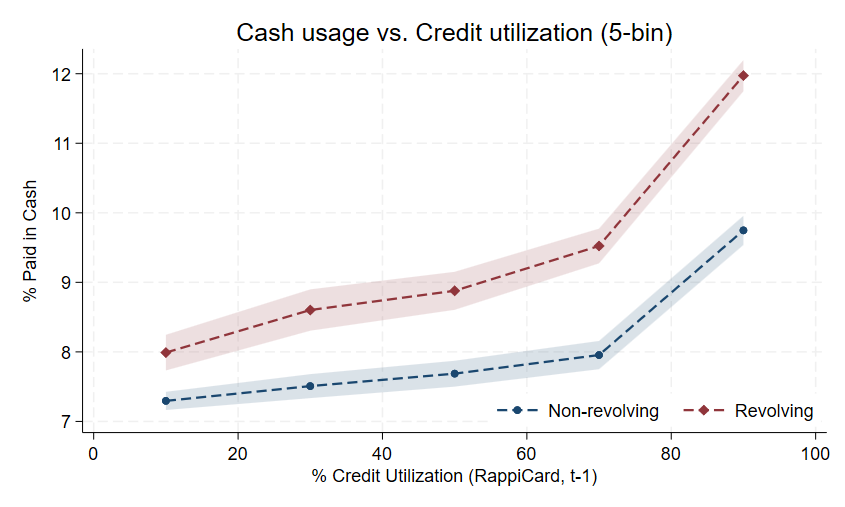
We study how a household's credit capacity shapes its choice between credit and cash payments. Linking 1.5 million transactions to households' real-time credit position, we find that cash usage rises in a convex pattern with credit utilization. This convexity is consistent with a precautionary mechanism: as credit capacity shrinks, the marginal value of available credit rises, driving up the cost of credit even for households that pay their balance in full. Households that carry a balance face an additional interest cost and use cash more often at every utilization level. Bank-initiated credit limit increases causally reduce cash usage. Inverting cash shares yields a monetary estimate of this cost: drawing down an additional dollar of credit costs 28 cents on average, half from the precautionary channel. Taken together, these results show that payment choice, conditioned on transaction-level credit position, directly measures the shadow cost of borrowing capacity.
Fintech to the (Worker) Rescue? Earned Wage Access, Worker Welfare and Employee Retention
Abstract
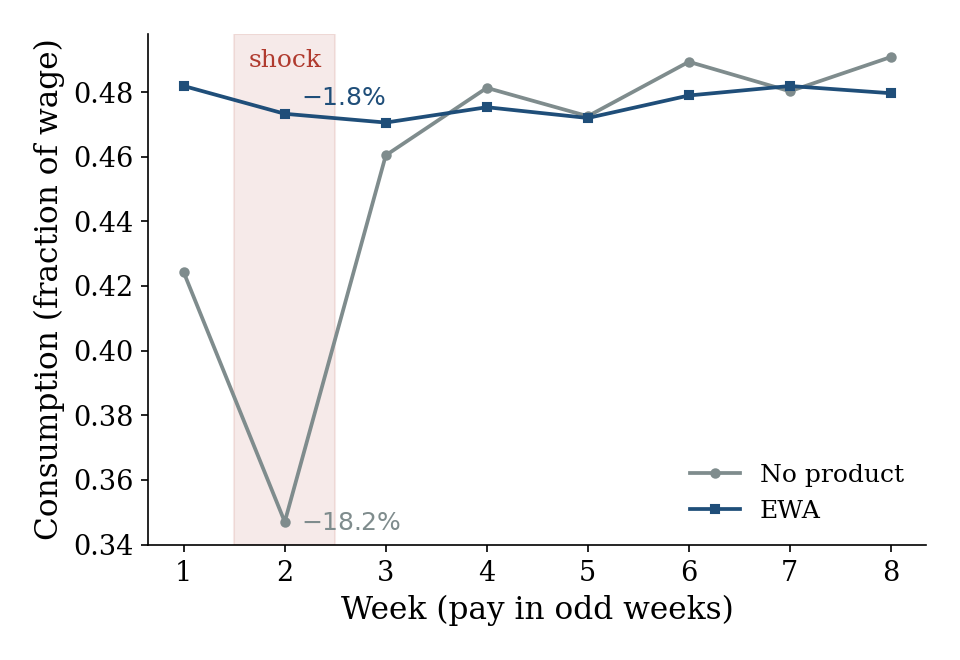
We study the usage and welfare implications of earned wage access (EWA) using administrative and survey data from a Mexican FinTech provider. Adoption is significant, and usage concentrates at the end of the pay cycle. We develop a stationary buffer-stock framework, calibrated to the data, in which EWA provides liquidity insurance and consumption-timing alignment. Access is worth about 2.5% of a paycheck per year for the average user, and an order of magnitude more for impatient, low-liquidity workers. Automatic repayment makes these gains more robust to present bias than with revolving credit. EWA usage is associated with higher employee retention, as the framework implies.
Riding the Waves: Geographic Diversification and Bank Responses to Local Funding Shocks
Abstract
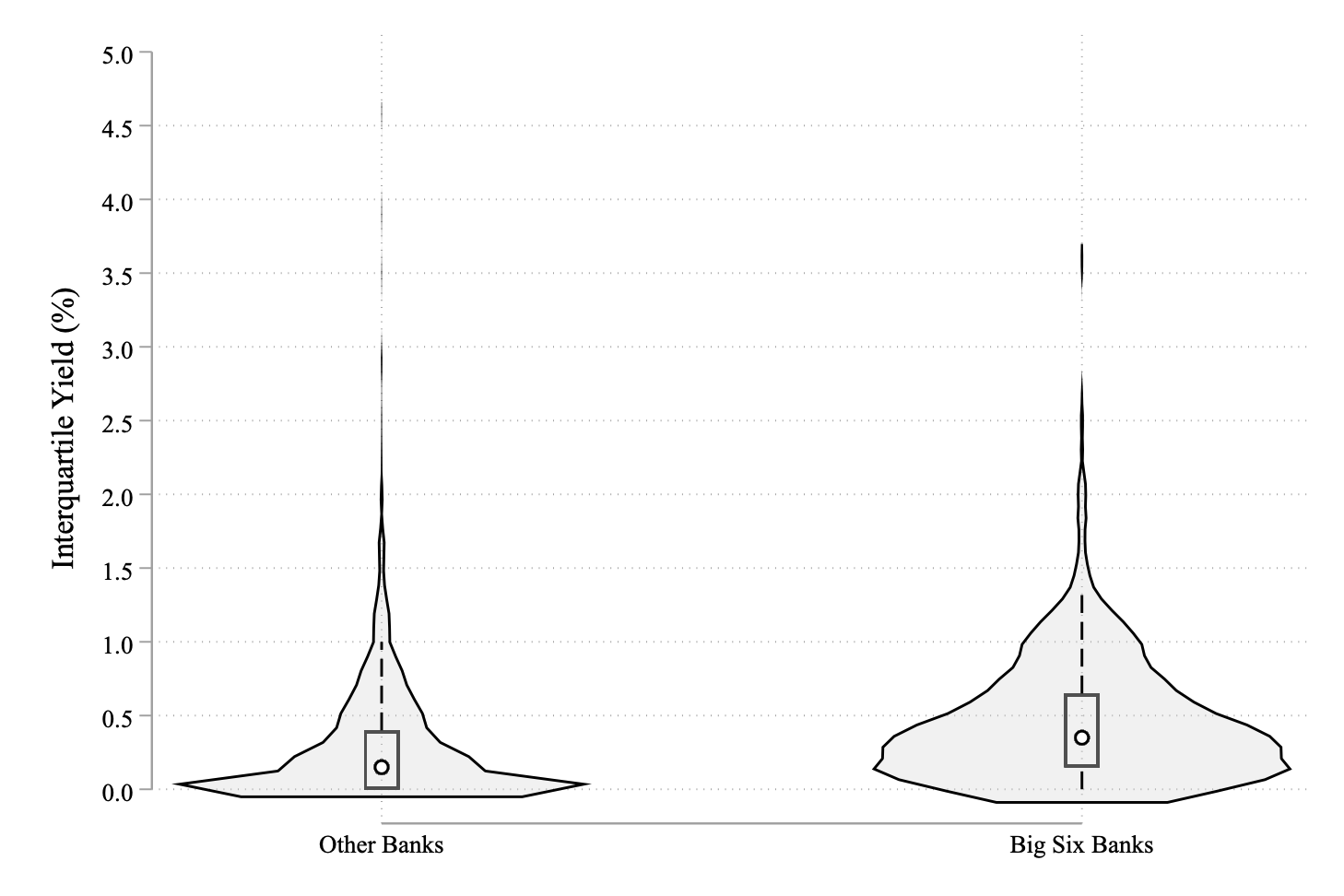
How resilient are banks to local funding shocks? We exploit a segment of Chinese wealth management products (WMPs) funded locally but backed by national assets, allowing us to isolate banks' strategic responses to local funding pressures. Using city-level inflation to characterize investor demand shifts, we find that banks pass through approximately 60% of these shocks to WMP yields. Large, geographically diversified banks respond more actively, by raising yields and contracting issuance in shock-hit markets more sharply than smaller banks. They then hedge by expanding the issuance of lower-yield WMPs in unaffected regions. Our findings reveal that for large banks, geographic diversification is not a tool for passive insulation but a mechanism enabling active, high-frequency liability management through their internal capital markets.